Pet ownership in Gurgaon has grown rapidly over the last few years, and with it comes the responsibility of ensuring your dog or cat is protected if they ever get lost. While collars and ID tags are useful, they can easily break, fall off, or be removed. A pet microchip offers a permanent form of identification that stays with your pet for life.
Whether you’re a first-time pet owner, planning to register your dog with the Municipal Corporation of Gurugram (MCG), preparing for international travel, or simply looking for extra peace of mind, microchipping is one of the smartest investments you can make in your pet’s safety.
Many pet parents wonder whether microchipping is painful, how much it costs, whether it tracks their pet’s location, and if it is mandatory in Gurgaon. The good news is that the procedure is quick, safe, and completed in just a few minutes by a qualified veterinarian. Once implanted and properly registered, a microchip significantly improves the chances of reuniting lost pets with their families.
In this comprehensive guide, you’ll learn everything about Pet Microchipping in Gurgaon, including costs, how RFID microchips work, the implantation process, registration, benefits, common myths, travel requirements, and how to choose the right veterinary clinic.

Pet Microchipping Cost in Gurgaon (2026)
The cost of pet microchipping depends on several factors, including the veterinary clinic, the quality of the microchip used, whether registration is included, and whether additional services such as health certificates or travel documentation are required.

Prices may differ depending on the veterinary hospital, type of microchip, and whether additional services are included.
What Is a Pet Microchip?
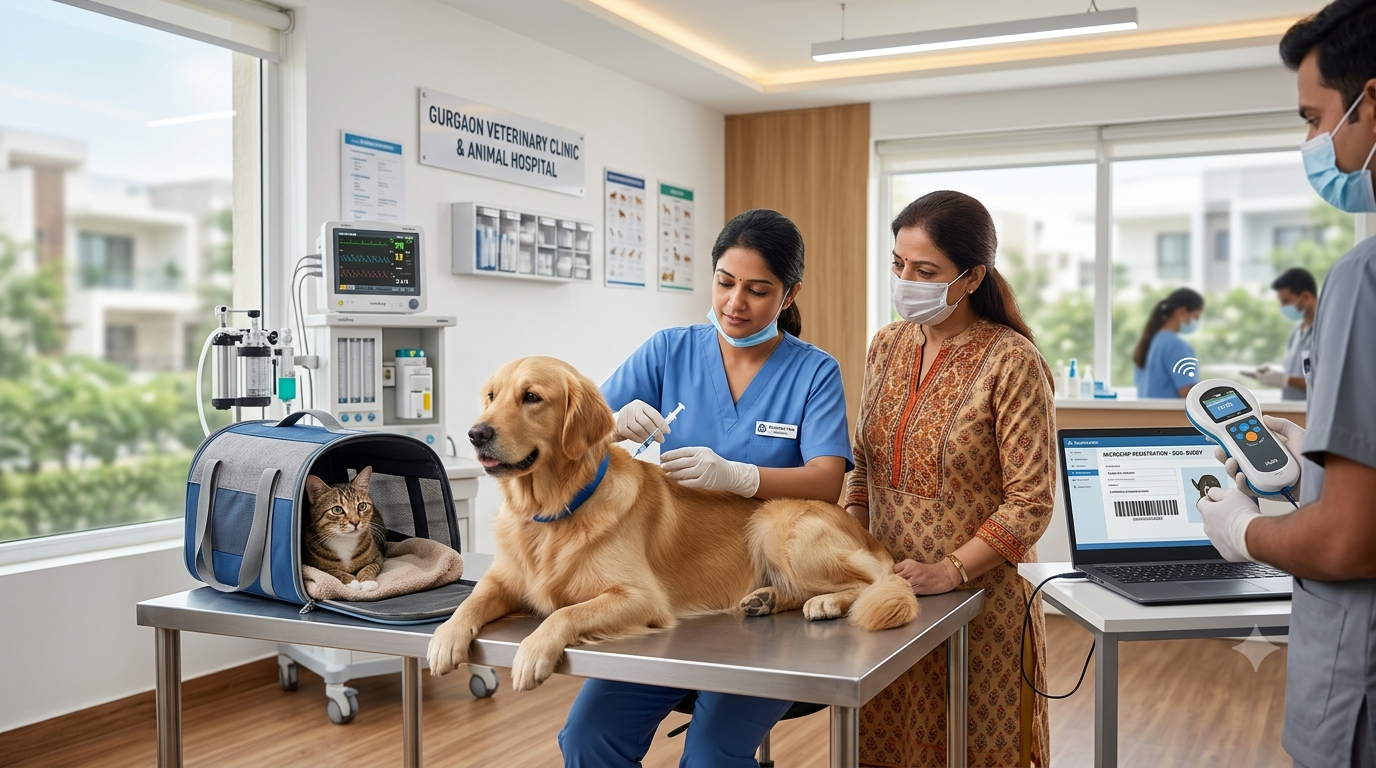
A pet microchip is a tiny electronic identification device approximately the size of a grain of rice. It is implanted just beneath the skin, usually between the shoulder blades, using a sterile applicator similar to a vaccination syringe.
Unlike a GPS tracker, a microchip does not continuously transmit your pet’s location. Instead, it contains a unique identification number that can be read using a compatible RFID scanner.
That identification number is linked to your contact information in a secure registration database. If your pet is ever found and scanned at a veterinary clinic, shelter, or animal rescue organization, the registered owner can be contacted.
Microchips are designed to last throughout your pet’s lifetime without requiring batteries, charging, or routine maintenance.

How Does a Pet Microchip Work?
Many owners mistakenly believe that microchips function like GPS tracking devices. In reality, they use passive Radio Frequency Identification (RFID) technology.
The microchip remains inactive until an RFID scanner is passed over the implantation site. The scanner emits a low-frequency radio signal that temporarily powers the chip, allowing it to transmit its unique identification number.
The scanner does not display the owner’s personal details. Instead, the identification number is matched with the information stored in the registration database, enabling veterinary professionals to contact the registered owner.
Since the chip contains only an identification number, protecting your privacy while ensuring reliable identification.
Why Microchips Do Not Need Batteries
Unlike GPS devices, pet microchips are passive electronic devices.
They remain dormant until activated by a compatible scanner. Because they only function during scanning, there is no battery to replace or recharge.
This allows the microchip to remain functional for many years, often for the lifetime of the pet.
Understanding ISO Standard Microchips
Most reputable veterinary clinics use ISO-compliant microchips that follow internationally recognized standards.
ISO-standard microchips improve compatibility with scanners used by veterinary hospitals, shelters, airports, and international animal health authorities.
Choosing an ISO-compliant chip becomes particularly important if you plan to travel internationally with your pet.
Step-by-Step Pet Microchipping Procedure
Many owners worry that microchipping is a surgical procedure. Fortunately, implantation is simple, minimally invasive, and usually completed during a routine veterinary appointment.

Step 1: Veterinary Examination
Your veterinarian first performs a general health examination to ensure your pet is suitable for the procedure.
This appointment is also an opportunity to discuss vaccination status, municipal registration, and travel plans if applicable.
Step 2: Preparing the Sterile Microchip
The veterinarian opens a sterile, single-use microchip applicator.
Each microchip contains a permanently programmed identification number that cannot be altered.
Step 3: Implantation
The microchip is gently inserted beneath the loose skin between the shoulder blades using a specially designed needle.
The process usually takes only a few seconds.
Most pets react similarly to receiving a routine vaccination.
Sedation or anesthesia is generally not required.
Step 4: Immediate Scanner Verification
Immediately after implantation, the veterinarian scans the microchip to confirm that it is functioning correctly.
This verification ensures that the identification number can be read successfully before your pet leaves the clinic.
Step 5: Registration
Implanting the microchip is only part of the process.
The unique identification number must be registered along with your contact information.
Without proper registration, even a perfectly functioning microchip cannot help reunite you with your pet.
Step 6: Documentation
Many veterinary hospitals provide documentation containing:
- Microchip number
- Implantation date
- Veterinary clinic details
- Registration information
- Implantation certificate
Keep these records in a safe place for future reference.
Why Registration Is More Important Than Implantation
One of the biggest misconceptions is that implanting a microchip automatically guarantees your pet can be identified.
In reality, the chip only contains an identification number.
If that number has not been linked to your contact information, veterinary professionals will have no way to contact you if your pet is found.
After registration, remember to update your details whenever you:
- Change your phone number
- Move to a new address
- Transfer ownership
- Adopt another owner
- Relocate internationally
Keeping your registration information current is just as important as implanting the chip itself.
Benefits of Pet Microchipping
Microchipping offers far more than permanent identification. It provides long-term security and supports responsible pet ownership.
A registered microchip greatly increases the likelihood of being reunited with a lost pet because veterinary clinics and shelters routinely scan stray animals for implanted chips.
Unlike collars or tags, microchips cannot be accidentally removed, damaged, or lost during outdoor activities. This makes them a reliable backup form of identification, especially for adventurous pets or those that frequently escape.
Microchipping also simplifies ownership verification during emergencies, helps maintain accurate medical records, supports insurance claims where applicable, and assists veterinary clinics in identifying pets that arrive unconscious or injured.
For families who travel with pets, a registered microchip can also be an essential part of domestic and international travel documentation.

When Should You Microchip Your Pet?
There is no single “perfect” age, but veterinarians generally recommend microchipping as early as it is medically appropriate, often during a routine vaccination visit.
Puppies and kittens can usually be microchipped at a young age, while adopted adult pets should ideally be microchipped soon after joining their new family.
Senior pets can also benefit from microchipping, particularly if they are prone to wandering due to age-related cognitive changes.
Early microchipping ensures permanent identification throughout your pet’s life and reduces the risk of delayed registration.
Microchip vs GPS Tracker: What’s the Difference?
One of the biggest misconceptions among pet owners is that a microchip can track their pet’s live location. This is not true. A pet microchip is designed solely for permanent identification, while a GPS tracker is intended for real-time location monitoring.
A microchip remains inactive until it is scanned with a compatible RFID scanner. It does not send signals, connect to satellites, require internet access, or use mobile networks. Instead, it stores a unique identification number linked to your contact details in a registration database.
A GPS tracker, on the other hand, continuously communicates with satellites or cellular networks to provide your pet’s live location through a smartphone application. However, GPS devices require batteries, regular charging, and a collar to remain attached to your pet.
The safest approach is to use both together. A GPS tracker helps you locate your pet immediately if they wander off, while a microchip serves as permanent identification if the collar is lost or removed.

Pet Microchip vs Collar ID Tag
Traditional collars and identification tags are still useful but should never be considered a replacement for microchipping.
Collars can break during play, become caught on fences, or simply slip off. Identification tags may fade over time or become unreadable after prolonged exposure to weather.
A microchip, however, remains beneath the skin throughout your pet’s life. Even if your pet loses its collar, the implanted chip continues to provide permanent identification.
Veterinarians generally recommend using both a collar with an ID tag and a registered microchip for maximum protection.
Pet Microchip vs Apple AirTag
Some pet owners use Apple AirTags or similar Bluetooth trackers on their pets. While these devices can be helpful in certain situations, they work very differently from microchips.
An AirTag depends on nearby Apple devices to update its location and must remain attached to your pet’s collar. If the collar falls off, the AirTag becomes useless.
A microchip never depends on batteries, Bluetooth, mobile signals, or internet connectivity. It cannot fall off because it is implanted beneath the skin and remains with your pet permanently.
For pets that spend time outdoors, combining an AirTag or GPS tracker with a microchip provides the highest level of security.
How Lost Pets Are Reunited Through Microchipping
Understanding the recovery process helps pet owners appreciate why registration is so important.
If a lost dog or cat is found, the person who rescues the animal often takes it to a nearby veterinary clinic, animal shelter, rescue organization, or municipal animal care facility.
The veterinarian scans the pet using a universal RFID scanner. If a microchip is present, the scanner displays the unique identification number.
The identification number is then matched with the registration database containing the owner’s contact information.
Once ownership is verified, the registered owner is contacted and arrangements are made to reunite the pet with its family.
Without registration, the identification number alone cannot identify the owner, making accurate database information essential.
Is Pet Microchipping Mandatory in Gurgaon?
Interest in pet microchipping has increased significantly as awareness about responsible pet ownership continues to grow.
Although local requirements may evolve over time, microchipping is increasingly recommended by veterinary professionals because it simplifies pet identification, supports responsible ownership, and complements municipal pet registration and record-keeping.
Many veterinary clinics encourage pet owners to combine microchipping with annual vaccinations, routine health checkups, and municipal registration to maintain complete identification records.
Before making legal or travel-related decisions, pet owners should always verify the latest requirements with the relevant authorities.
Pet Microchipping and Municipal Registration
Municipal pet registration focuses on maintaining records of licensed pets, vaccination status, and ownership information.
A microchip strengthens this process by providing permanent identification that cannot be removed or altered.
When ownership records remain accurate and updated, identifying lost pets becomes faster and more reliable.
Many responsible pet owners now choose to complete vaccination, registration, and microchipping during the same veterinary visit.
Is Pet Microchipping Required for International Travel?
For pet owners planning international relocation, microchipping is often one of the first requirements that must be completed before travel documentation can be processed.
Many countries require pets to have an ISO-compliant microchip before rabies vaccination, blood tests, health certification, or import permits are issued.
Because every destination has different regulations, owners should begin planning several months before departure.
Veterinary hospitals experienced in pet relocation can guide owners through microchipping, vaccination schedules, export documentation, and country-specific health requirements.
Even when travelling within India, maintaining permanent identification provides additional security if pets become separated during transport.

Is Pet Microchipping Safe?
Pet microchipping has been used worldwide for many years and is considered one of the safest methods of permanent animal identification.
The implanted device is biocompatible, extremely small, and specifically designed to remain comfortably beneath the skin.
Most pets experience only mild discomfort comparable to receiving a routine vaccination.
Serious complications are uncommon when implantation is performed by an experienced veterinarian using sterile techniques.
Routine veterinary examinations may include scanning the chip to confirm that it remains readable and correctly positioned.

Does Microchipping Hurt?
This is one of the most frequently asked questions by pet owners.
The implantation needle is slightly larger than a vaccination needle because it contains the microchip. However, the procedure lasts only a few seconds.
Most dogs and cats react briefly during insertion and quickly return to normal behaviour.
The vast majority of pets require no sedation or anaesthesia.
Any temporary discomfort usually resolves almost immediately.
Possible Side Effects
Side effects following implantation are generally mild and uncommon.
Some pets may experience slight swelling at the implantation site for a short period. Mild tenderness may also occur immediately after the procedure.
Very rarely, a microchip may shift slightly beneath the skin, but this generally does not interfere with its ability to be scanned.
Veterinary professionals recommend monitoring the implantation area for the first few days and contacting the clinic if unusual swelling or persistent discomfort develops.
Common Myths About Pet Microchips
Many misconceptions discourage owners from microchipping their pets despite its proven benefits.
One common myth is that a microchip functions like GPS. In reality, it only stores an identification number and cannot track your pet’s location.
Another misconception is that the chip stores personal information. It actually contains only a unique identification code, while owner details remain securely stored in a registration database.
Some owners believe the chip requires charging or battery replacement. Passive RFID microchips contain no battery and require no maintenance throughout your pet’s lifetime.
Others worry that the chip will stop working after a few years. High-quality veterinary microchips are designed to remain functional for many years, often for the pet’s entire life.
Another myth suggests that microchips interfere with routine medical imaging. Modern veterinary microchips are generally compatible with standard diagnostic procedures, although you should always inform your veterinarian that your pet has been microchipped before advanced imaging is performed.
Can a Microchip Move Inside the Body?
After implantation, minor movement beneath the skin can occasionally occur during the first few weeks.
In most cases, the chip settles within the tissue near the implantation site and remains there permanently.
Even if slight migration occurs, experienced veterinarians can usually locate and scan the chip without difficulty.
Routine annual scanning during wellness examinations helps confirm that the chip remains functional.
How to Choose the Best Veterinary Clinic for Pet Microchipping in Gurgaon
Selecting the right veterinary clinic is just as important as choosing to microchip your pet.
Choose a clinic where experienced veterinarians perform the implantation using high-quality ISO-compliant microchips. The clinic should verify the chip immediately after insertion using a scanner and assist you with completing the registration process.
It is also helpful to choose a veterinary hospital that maintains digital medical records and offers preventive healthcare services such as vaccinations, annual health checkups, travel certification, and municipal registration guidance. This ensures your pet’s identification records remain accurate and accessible throughout its lifetime.
A reputable clinic will also explain aftercare, provide documentation of the implanted microchip, and advise you on updating your registration details whenever your contact information changes.
Pet Microchipping Aftercare: What to Do After the Procedure
One of the biggest advantages of pet microchipping is that there is very little recovery time. Unlike surgery, the procedure is completed within a few minutes, and most dogs and cats can return to their normal routine almost immediately.
Even though complications are rare, proper aftercare helps ensure that the implantation site heals well and the microchip remains correctly positioned.
For the first 24 to 48 hours, monitor the implantation area for mild swelling or tenderness. These reactions are generally temporary and resolve on their own.
Avoid excessive rough play immediately after implantation, especially for energetic puppies and large breed dogs. Gentle activity is perfectly acceptable unless your veterinarian advises otherwise.
If you notice persistent swelling, discharge, bleeding, excessive scratching at the implantation site, or signs of pain lasting more than a couple of days, schedule a veterinary examination.
Most importantly, keep your implantation certificate and registration details in a safe place.

Annual Microchip Verification Is Just as Important
Many owners assume that once the microchip is implanted, nothing further needs to be done.
In reality, veterinarians recommend scanning the chip during your pet’s annual health examination to ensure it remains readable.
Although quality microchips rarely fail, routine verification provides peace of mind and confirms that the identification number can still be detected correctly.
It is also the ideal time to confirm that your registered phone number, email address, and residential address remain up to date.
This simple annual check takes only a few seconds but could make all the difference if your pet is ever lost.

When Should You Update Your Microchip Registration?
Implanting the chip is only the first step.
Whenever your personal information changes, the registration database should be updated immediately.
This includes changing your mobile number, moving to a new address, transferring ownership to another family member, adopting a rescued pet, or relocating to another city or country.
Many pets are scanned every year but cannot be reunited with their families because the owner’s contact details are no longer current.
Keeping your registration updated is one of the most important responsibilities of pet ownership.
Can a Pet Be Microchipped More Than Once?
In most situations, one properly functioning microchip is all a pet will ever need.
If an older chip cannot be detected, becomes damaged, or does not meet international standards for travel, your veterinarian may recommend implanting a new ISO-compliant microchip.
Both identification numbers should be properly documented to avoid confusion in future medical records or travel documentation.
Does Microchipping Affect MRI, X-rays, or CT Scans?
This is a common concern among pet owners, particularly those whose pets require advanced diagnostic imaging.
Modern veterinary microchips are designed to be compatible with routine diagnostic procedures, including X-rays, CT scans, and MRI examinations.
The implanted microchip does not function as a GPS device and contains no battery or moving electronic components.
However, it is always good practice to inform your veterinarian or radiologist that your pet has been microchipped before undergoing advanced imaging.
Can Microchips Be Removed?
Microchips are intended to remain beneath the skin for your pet’s entire lifetime.
They do not normally need to be removed or replaced.
Removal is generally considered only in exceptional medical situations and should always be performed by a qualified veterinarian.
For healthy pets, the safest approach is simply to leave the implanted chip in place and keep the registration information updated.
Expert Recommendations for Pet Owners
Veterinary professionals agree that microchipping should be viewed as one component of a complete identification strategy rather than the only one.
A registered microchip should always be complemented by a collar carrying a visible identification tag.
Owners who frequently travel or have adventurous pets may also consider using a GPS tracker for real-time location monitoring while relying on the microchip for permanent identification.
Routine veterinary examinations, annual vaccinations, preventive healthcare, municipal registration where applicable, and updated microchip records together provide the highest level of protection for your pet.
Why More Pet Owners in Gurgaon Are Choosing Microchipping
As pet ownership continues to grow across Gurgaon, awareness about responsible pet care has increased significantly.
Modern veterinary hospitals now encourage permanent identification alongside routine vaccinations, annual wellness examinations, sterilization, and preventive healthcare.
Microchipping has become especially valuable for pets visiting boarding facilities, grooming centres, training schools, daycare facilities, apartment communities, and public parks where accidental separation may occur.
It also provides additional confidence for families relocating within India or planning international travel with their pets.
Is Pet Microchipping Worth the Cost?
Considering that a quality pet microchip remains functional for your pet’s lifetime, the overall cost is relatively small compared to the protection it offers.
A single implantation can permanently identify your pet even if collars, tags, or GPS devices are lost.
For owners who view pets as family members, microchipping is one of the simplest yet most valuable investments in lifelong safety.
Frequently Asked Questions
Q1. How much does pet microchipping cost in Gurgaon?
Ans: Pet microchipping generally costs between ₹1,000 and ₹2,500, depending on the clinic and services included.
Q2. Is microchipping painful?
Ans: The procedure causes only brief discomfort similar to a routine vaccination.
Q3. Does a microchip track my pet’s location?
Ans: No. A microchip is an identification device and cannot provide live GPS tracking.
Q4. Where is the microchip implanted?
Ans: It is usually implanted beneath the skin between the shoulder blades.
Q5. How long does the procedure take?
Ans: Most implantations are completed within a few minutes.
Final Thoughts
Pet microchipping is one of the simplest, safest, and most effective ways to protect your dog or cat for life. Unlike collars and tags that can be lost or damaged, a microchip provides permanent identification that remains with your pet throughout its lifetime. When combined with proper registration and regular veterinary care, it significantly increases the likelihood of reuniting lost pets with their families.
As veterinary care continues to advance in Gurgaon, more clinics now offer quick and affordable microchipping using ISO-compliant RFID technology. Whether you have a playful puppy, a curious indoor cat, a senior companion, or a newly adopted rescue pet, microchipping is a small one-time investment that can provide lifelong peace of mind.
The best results come from combining microchipping with responsible pet ownership practices, including routine vaccinations, annual health checkups, municipal registration where applicable, visible ID tags, and updated contact information. Taking these simple steps today can make all the difference if your pet ever becomes separated from you.