Cats are masters at hiding pain. Unlike dogs, they rarely cry, limp dramatically, or show obvious signs when something is wrong. A cat with a fractured bone may continue walking. A cat with bladder stones may quietly stop eating. Even serious conditions like intestinal blockages, pneumonia, or internal injuries often develop with only subtle warning signs. By the time many owners realize their pet is unwell, the illness may have already progressed.
This is exactly why diagnostic imaging plays such an important role in modern feline medicine. A physical examination can tell a veterinarian a great deal, but it cannot reveal what is happening inside your cat’s chest, abdomen, spine, or bones. That’s where a veterinary X-ray becomes invaluable.
Whether your cat has fallen from a balcony, swallowed a foreign object, developed breathing difficulties, started limping, or is experiencing unexplained vomiting, a digital X-ray is often one of the fastest and most effective diagnostic tools available. Within minutes, veterinarians can identify fractures, bladder stones, intestinal obstructions, lung infections, heart enlargement, arthritis, pregnancy, and many other conditions that would otherwise remain hidden.

Naturally, one of the first questions pet owners ask is:
“How much does a cat X-ray cost in Gurgaon?”
The answer depends on several factors, including the body part being examined, the number of X-ray views required, whether sedation is necessary, whether the imaging is performed during an emergency, and the veterinary hospital you choose.
Fortunately, Gurgaon has become one of India’s leading cities for advanced veterinary care. Many multi-specialty pet hospitals now offer digital radiography, ultrasound, pathology laboratories, intensive care units, advanced surgical facilities, and emergency services under one roof. This has significantly improved the speed and accuracy of diagnosing feline illnesses while making treatment more efficient.
Cat X-ray cost in Gurgaon in 2026

What Is a Cat X-Ray?
A cat X-ray, also called a radiograph, is a diagnostic imaging technique that uses carefully controlled, low-dose radiation to create detailed images of your cat’s bones and internal organs.
Although many pet owners associate X-rays with broken bones, veterinarians use them for far more than orthopedic injuries. X-rays help evaluate the lungs, heart, abdomen, digestive system, urinary tract, joints, spine, skull, and even pregnancy during the later stages of gestation.
Unlike blood tests, which reveal changes occurring inside the body at a biochemical level, X-rays allow veterinarians to actually visualize internal structures. They can detect abnormalities such as fractures, swallowed foreign objects, bladder stones, enlarged organs, arthritis, spinal disorders, fluid accumulation, certain tumors, and many other conditions that cannot be diagnosed through a physical examination alone.
Today, most advanced veterinary hospitals in Gurgaon use digital X-ray systems instead of traditional film radiography. Digital imaging produces clearer, high-resolution images within minutes while exposing pets to lower radiation levels than older equipment. It also allows veterinarians to enlarge images, adjust contrast, and share reports electronically when specialist opinions are required.
Because of these advantages, digital radiography has become one of the most important diagnostic tools in modern feline healthcare.

When Does a Cat Need an X-Ray?
Veterinarians recommend X-rays whenever they suspect a condition affecting your cat’s bones, chest, abdomen, or internal organs that cannot be confirmed through a routine examination alone.
Traumatic injuries are among the most common reasons. Cats that fall from balconies, are involved in road accidents, or sustain injuries during fights often require immediate radiographic evaluation to identify fractures, joint dislocations, spinal injuries, or internal bleeding.
Digestive disorders are another frequent reason for X-ray imaging. If your cat repeatedly vomits, stops eating, experiences constipation, develops abdominal swelling, or is suspected of swallowing a foreign object such as string, thread, toys, plastic, bones, or fabric, radiographs help determine whether an intestinal blockage or obstruction is present.
Respiratory illnesses also commonly require chest X-rays. Difficulty breathing, persistent coughing, suspected pneumonia, asthma, fluid accumulation, lung disease, or enlargement of the heart are all conditions where radiography provides valuable diagnostic information.
Urinary tract disease represents another important indication. Cats suffering from difficulty urinating, blood in the urine, or repeated urinary infections may undergo abdominal X-rays to identify bladder stones or urinary tract abnormalities.
The cost of a cat X-ray depends on much more than simply taking a picture. Pricing varies according to the body part being examined, the number of views required, whether sedation is needed, emergency consultation charges, and the facilities available at the veterinary hospital.
In Gurgaon, most veterinary hospitals offer digital X-ray services, which provide excellent image quality and faster diagnosis compared to older film-based systems.
The table below provides approximate pricing for common feline X-ray procedures in 2026.
| X-Ray Procedure | Estimated Cost |
| Single digital X-ray | ₹600–₹1,500 |
| Two-view X-ray study | ₹1,200–₹2,500 |
| Chest X-ray | ₹1,000–₹2,500 |
| Abdominal X-ray | ₹1,200–₹3,000 |
| Orthopedic X-ray | ₹1,200–₹3,500 |
| Spine or skull X-ray | ₹1,500–₹4,000 |
| Pregnancy X-ray | ₹1,000–₹2,500 |
| Dental X-ray (where available) | ₹1,500–₹3,500 |
| Sedation (if required) | ₹800–₹2,000 |
| Emergency imaging charges | Additional fees may apply |
These figures represent approximate estimates and may vary depending on the complexity of the case, the veterinary hospital, specialist involvement, and additional diagnostic tests that may be required.
Although pricing is important, choosing a hospital with experienced veterinarians, modern digital radiography equipment, comprehensive diagnostic facilities, and appropriate emergency support is often far more valuable than selecting the lowest-cost option.
Why Do Cat X-Ray Costs Vary Between Veterinary Hospitals?
Many pet owners are surprised to receive different estimates from different clinics for what appears to be the same procedure. However, the quoted price reflects far more than simply operating an X-ray machine.
One major factor is the type of imaging equipment being used. Modern digital radiography systems produce clearer images almost instantly, allowing veterinarians to identify subtle abnormalities that might not be visible on older film-based machines. Hospitals that invest in advanced technology often have higher operating costs, which are reflected in their pricing.
Another important consideration is the number of X-ray views required. While a single image may be sufficient for some injuries, many conditions require two or three different angles to accurately evaluate bones, joints, or internal organs. Additional views naturally increase the total cost but also improve diagnostic accuracy.
Sedation is another variable. Calm cats may tolerate positioning without medication, while frightened, aggressive, or painful patients often require mild sedation to obtain high-quality images safely. Sedation involves additional drugs, monitoring, and recovery time, all of which contribute to the final bill.
Furthermore, emergency appointments outside normal clinic hours, specialist interpretation, consultation fees, blood tests, ultrasound examinations, and follow-up diagnostics may all be billed separately depending on your cat’s medical condition.
Rather than comparing prices alone, pet owners should consider the overall quality of care, diagnostic accuracy, and treatment facilities available at the hospital.

Digital X-Ray vs Traditional X-Ray: What’s the Difference?
Modern veterinary hospitals in Gurgaon have largely replaced traditional film-based X-rays with digital radiography, offering significant advantages for both veterinarians and pet owners.
Traditional X-rays require films to be developed before they can be examined, which takes additional time and may produce lower-quality images. Digital X-rays, on the other hand, generate high-resolution images within seconds, allowing veterinarians to evaluate your cat almost immediately.
Digital systems also allow images to be enlarged, adjusted for brightness and contrast, and shared electronically with specialists if a second opinion is required. Since image quality is significantly better, subtle fractures, small bladder stones, lung abnormalities, and early joint changes are often easier to identify.
Another benefit is reduced radiation exposure. Modern digital equipment typically requires less radiation than older film-based systems while still producing clearer diagnostic images. This improves safety for both pets and veterinary staff.
For these reasons, digital X-rays have become the preferred imaging method in most advanced veterinary hospitals and referral centers.

Common Conditions Diagnosed Through Cat X-Rays
Although many people associate X-rays with broken bones, they are used to diagnose a wide variety of feline health conditions.
Orthopedic injuries remain one of the most common reasons for imaging. Cats that have fallen from heights, been involved in road accidents, or sustained injuries during fights may require X-rays to identify fractures, joint dislocations, spinal injuries, or pelvic trauma.
Chest radiographs are commonly used to investigate breathing problems. They help veterinarians diagnose pneumonia, asthma, collapsed lungs, fluid around the lungs, enlarged hearts, and certain tumors affecting the chest cavity.
Abdominal X-rays play an important role in diagnosing digestive disorders. They help detect swallowed foreign objects, intestinal obstruction, constipation, enlarged organs, bladder stones, kidney stones, and certain abdominal masses.
Veterinarians also use radiographs to evaluate arthritis, hip disorders, degenerative joint disease, spinal abnormalities, and chronic orthopedic conditions, particularly in older cats.
During pregnancy, X-rays can estimate the number of kittens in the uterus during the later stages of gestation and assist veterinarians in preparing for delivery if complications are anticipated.
Because many illnesses produce similar symptoms, radiographs often provide valuable information that helps narrow down the diagnosis quickly and accurately.

What Does the X-Ray Cost Usually Include?
Many pet owners assume they are paying only for the image itself, but a veterinary X-ray involves several important components.
In most hospitals, the quoted fee generally includes the imaging procedure, digital image acquisition, positioning by trained veterinary staff, interpretation by the attending veterinarian, and discussion of the findings with the pet owner.
However, additional services are often billed separately depending on your cat’s condition. These may include consultation fees, sedation, blood tests, repeat imaging, ultrasound examinations, medications, hospitalization, emergency consultation charges, or referral to a veterinary specialist.
Requesting a detailed written estimate before proceeding helps you understand exactly what is included and minimizes unexpected expenses.
How Is a Cat X-Ray Performed?
The procedure itself is relatively straightforward, although the exact process depends on the medical condition being investigated.

1. Clinical Examination
Before recommending imaging, the veterinarian performs a complete physical examination to determine which body region requires evaluation. Your cat’s medical history, symptoms, previous illnesses, and recent injuries are carefully reviewed.
If multiple conditions are suspected, the veterinarian may recommend imaging of more than one body area.
2. Positioning
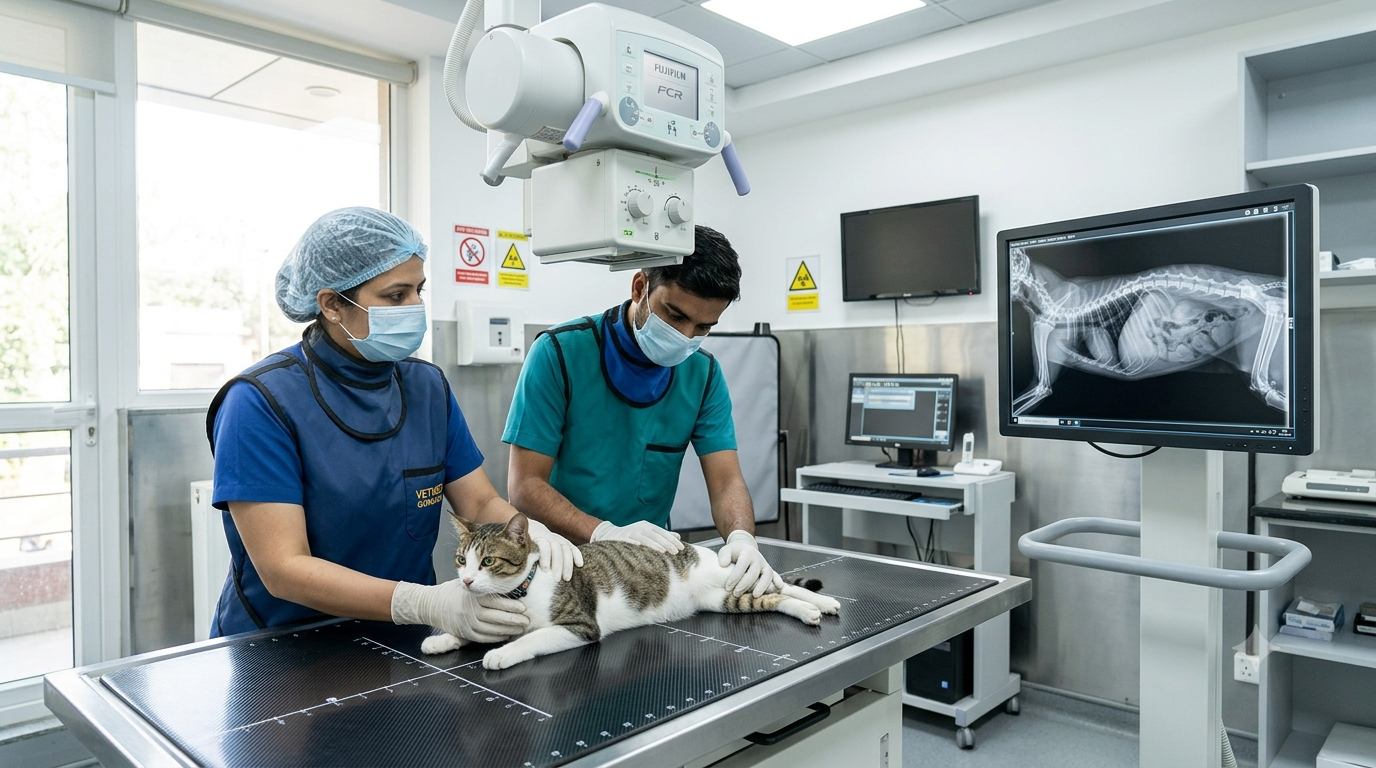
Your cat is gently positioned on the digital X-ray table by trained veterinary staff. Correct positioning is essential because even slight movement can reduce image quality or make interpretation more difficult.
Different conditions require different views. For example, chest radiographs often involve lateral and ventrodorsal projections, while orthopedic evaluations may require multiple angles to fully assess fractures or joint injuries.
3. Image Acquisition
Once your cat is properly positioned, the X-ray machine captures the required images within a fraction of a second. The procedure itself is painless, and the radiation exposure is extremely low.
Digital images appear on the computer almost immediately, allowing veterinarians to review them during the same consultation in many cases.
4. Image Interpretation
The veterinarian carefully evaluates the radiographs, looking for abnormalities involving bones, joints, lungs, heart, digestive organs, urinary tract, or other structures.
If additional clarification is needed, the images may be shared with a veterinary radiologist or specialist for further interpretation.
Does Every Cat Need Sedation for an X-Ray?
No. Many cats undergo routine X-rays without any form of sedation.
Calm, cooperative cats usually tolerate the procedure well, particularly when only one or two images are required. However, sedation becomes necessary in certain situations.
Cats experiencing severe pain may struggle to remain still because movement causes discomfort. Nervous or aggressive cats may also require mild sedation to reduce stress and ensure safe handling.
Sedation is sometimes recommended for detailed orthopedic examinations, spinal imaging, dental radiographs, or when multiple views are needed.
Using sedation not only improves image quality but also reduces the risk of injury to both the cat and veterinary staff.
The decision is always based on your cat’s temperament, medical condition, and the type of examination being performed.
Is Sedation Safe?
Sedation is generally considered very safe when administered by experienced veterinarians after evaluating your cat’s overall health.
Older cats or those with heart, liver, or kidney disease may require blood tests before sedation to ensure medications can be administered safely.
Throughout the procedure, veterinary staff monitor breathing, heart rate, oxygen levels, and overall patient comfort.
Most cats recover from mild sedation within a few hours, although some may remain sleepy until later in the day. Providing a quiet environment at home and following your veterinarian’s instructions usually allows a smooth recovery.
Is a Cat X-Ray Painful?
The X-ray itself is completely painless.
However, if your cat has a fracture, severe arthritis, spinal injury, or abdominal pain, gentle positioning during imaging may cause temporary discomfort. Veterinary professionals are trained to handle injured animals carefully while minimizing unnecessary movement.
When positioning becomes too uncomfortable, sedation is often recommended to reduce pain and obtain clearer images without causing additional stress.
How Long Does a Cat X-Ray Take?
The imaging process itself usually takes only a few minutes.
Most appointments, including examination, positioning, image acquisition, and discussion of results, are completed within fifteen to thirty minutes.
If sedation is required, the visit may last one to three hours because additional time is needed for preparation, recovery, and post-sedation monitoring.
Emergency cases involving trauma or multiple injuries may require additional imaging and stabilization before treatment decisions are made.
X-Ray vs Ultrasound: Which Diagnostic Test Is Better?
Pet owners are often unsure whether their cat needs an X-ray or an ultrasound. While both are valuable diagnostic tools, they serve different purposes and are frequently used together rather than as alternatives.
X-rays are generally the first choice when veterinarians need to evaluate bones, joints, the lungs, the heart, swallowed foreign objects, bladder stones, or intestinal obstruction. They provide an excellent overview of the body’s structure and are particularly useful for detecting fractures, arthritis, chest disease, and mineralized stones.
Ultrasound, on the other hand, is better suited for examining soft tissues and internal organs. It allows veterinarians to evaluate the liver, kidneys, spleen, pancreas, intestines, urinary bladder, reproductive organs, and fluid accumulation within the abdomen. Ultrasound is also commonly used to guide needle biopsies and assess organ function.
In many cases, veterinarians recommend both tests because they provide complementary information. An X-ray may identify an enlarged organ, while an ultrasound helps determine the underlying cause. Using both imaging techniques together often leads to a faster and more accurate diagnosis.

What Happens After the X-Ray?
Once the images have been reviewed, your veterinarian will discuss the findings and recommend the next steps based on your cat’s condition.
If the X-rays are normal, your veterinarian may suggest additional diagnostic tests such as blood work, ultrasound, urine analysis, or advanced imaging like CT or MRI if symptoms persist.
If fractures or orthopedic injuries are detected, treatment may involve splints, surgery, pain management, or strict cage rest depending on the severity of the injury.
When bladder stones, intestinal blockages, or swallowed foreign objects are identified, further treatment may include medication, dietary changes, endoscopy, or surgery.
Cats diagnosed with pneumonia, asthma, or heart disease may require hospitalization, oxygen therapy, long-term medications, or referral to a veterinary specialist.
Because X-rays provide valuable diagnostic information rather than treatment themselves, the findings help veterinarians develop the most appropriate treatment plan for your cat.
Recovery After Sedation
Most cats recover quickly after mild sedation.
Your veterinarian will usually observe your cat until it is awake, stable, and able to walk safely before allowing discharge. Once home, your cat should be kept indoors in a warm, quiet environment away from stairs, balconies, or other potential hazards until fully alert.
Some cats may appear sleepy, slightly unsteady, or less interested in food for a few hours. These effects generally resolve on the same day.
Fresh water should always be available, and food should be offered according to your veterinarian’s recommendations. If vomiting, breathing difficulty, prolonged drowsiness, or unusual behavior develops after returning home, contact your veterinary hospital immediately.
Most healthy cats recover completely from mild sedation within several hours and return to their normal routine by the following day.
Choosing the Right Veterinary Hospital for Cat X-Rays in Gurgaon
Selecting the right veterinary hospital is just as important as understanding the cost of the procedure. A high-quality digital X-ray interpreted by an experienced veterinarian can significantly improve diagnostic accuracy and help your cat receive appropriate treatment sooner.
When comparing veterinary hospitals, look for facilities that offer modern digital radiography, experienced veterinarians familiar with feline medicine, in-house laboratory services, ultrasound, emergency care, and surgical support. Hospitals equipped with comprehensive diagnostic facilities can often complete multiple investigations during a single visit, reducing delays in diagnosis.
If your cat has a complicated medical condition, ask whether the hospital has access to veterinary specialists or referral services for advanced imaging and surgery if required.
It is also worthwhile discussing the estimated cost before the procedure begins. A written estimate explaining consultation charges, imaging fees, sedation, medications, and any additional diagnostic tests provides greater transparency and helps owners make informed decisions.
Rather than choosing a hospital based solely on price, consider the quality of diagnostic equipment, medical expertise, emergency facilities, and overall standards of patient care.

When Should You Seek Immediate Veterinary Care?
Certain situations require urgent medical attention rather than waiting for a routine appointment.
Seek immediate veterinary care if your cat has been involved in a road accident, fallen from a height, experiences difficulty breathing, repeatedly vomits, cannot urinate, suddenly becomes unable to walk, develops severe abdominal swelling, has a suspected fracture, swallows a foreign object, suffers a seizure, or collapses unexpectedly.
Prompt diagnostic imaging often allows veterinarians to identify life-threatening conditions quickly and begin appropriate treatment before complications become more severe.
Attempting to treat these conditions at home can delay essential care and may place your cat’s health at greater risk.
Final Thoughts
A veterinary X-ray is one of the most valuable diagnostic tools available in modern feline medicine. Whether your cat has suffered an injury, developed breathing problems, stopped eating, experienced persistent vomiting, or is suspected of swallowing a foreign object, digital radiography provides veterinarians with rapid and accurate information that guides treatment decisions.
In Gurgaon, the cost of a cat X-ray generally ranges from ₹600 to ₹5,000, depending on the body part being examined, the number of radiographic views required, whether sedation is necessary, and the facilities available at the veterinary hospital. While additional tests such as blood work or ultrasound may increase the overall cost, these investigations often provide critical information that leads to a faster and more accurate diagnosis.
Early diagnosis is one of the biggest advantages of modern veterinary imaging. Detecting fractures, bladder stones, intestinal blockages, respiratory disease, or orthopedic problems before they worsen can reduce treatment costs, improve recovery, and prevent potentially life-threatening complications.